This is a series I want to write to highlight poets who have been important to my development, but may not be widely read or often discussed. This will not be a comprehensive biography or even a coherent essay, rather a collection of my thoughts on these writers, what they mean to me, and where to find their work.
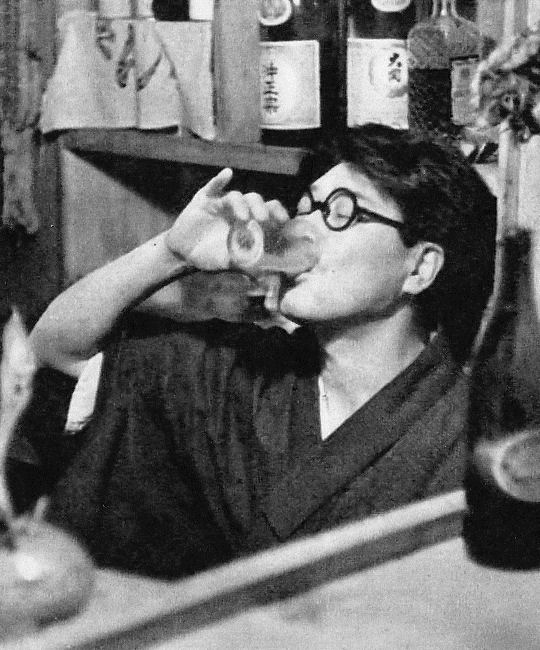
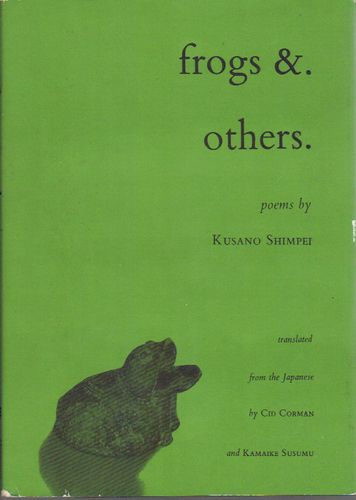
The first poet I want to write about is the Japanese poet Kusano Shinpei. Kusano was born May 12, 1903, in Kami-Ogawa Village, Ishiki District, Fukushima Prefecture, Japan. I was first introduced to his work by poet Jeffery Beam. While visiting Beam at his home he showed me his copy of frogs &. others, translated by Cid Corman (a poet who deserves a post of his own). I was immediately struck by the beauty of his work and immediately ran off to find more of it.
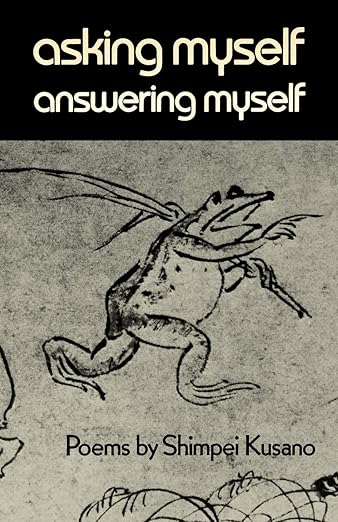
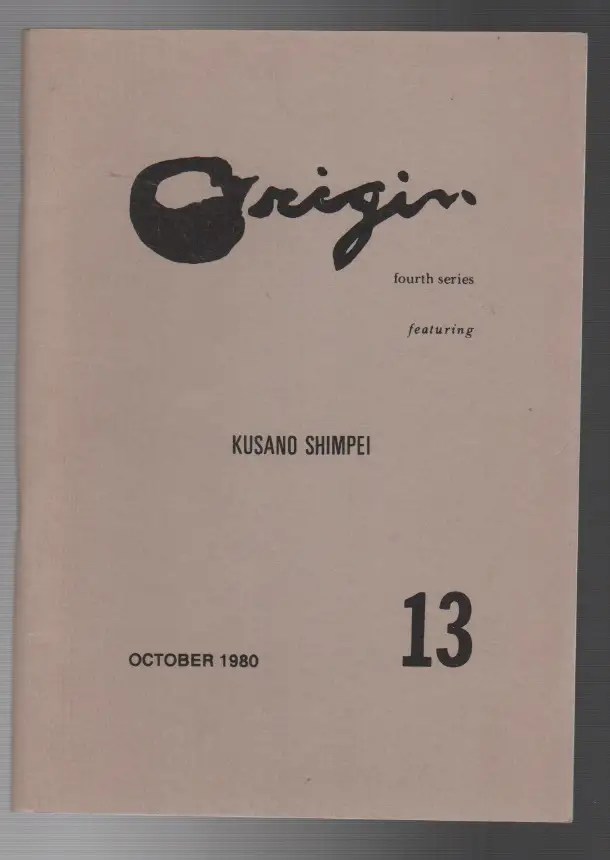
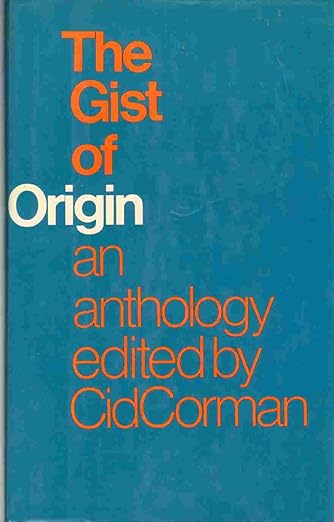
The next two pieces of his work I collected were 1984’s asking myself/answering myself, published by New Directions, and Origin 13 (and by extension the anthology The Gist of Origin). Both of these offerings were once again translated by the great Cid Corman. I fell deeper and deeper into Kusano Shinpei’s world.
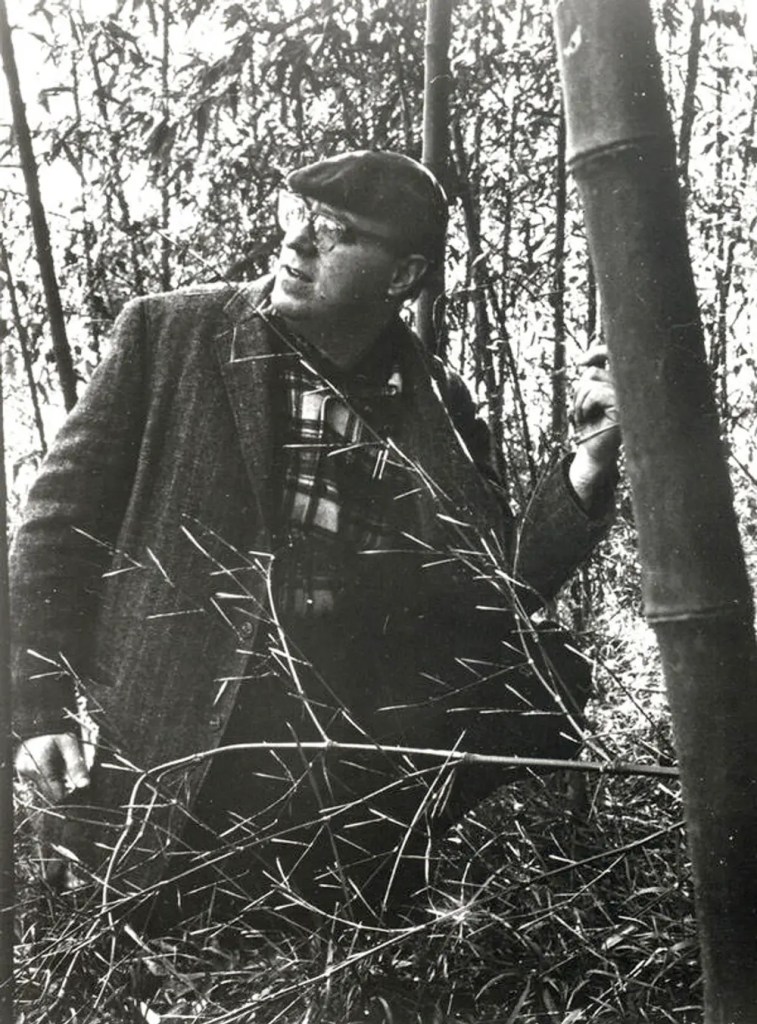
I have included four poems by Kusano Shinpei below. All are translated by Cid Corman and Susumu Kamaike.
Rock
in rain wet by it.
by itself.
rock is.
is millions of years.
in vague.
mist.
Half a Sun
after Fuji’s.
left side sun coming in.
from top north.
flowing steep down perhaps no cloud.
quick black snow smoke.
shaking sinking sliding away. moment.
jumps.
crimson pudding.
o half a sun now.
mightiest member of the universe.
blind my two upstanding eyes with a whack of light.
frog
dream.
beyond mountain horizon.
back.
knows pit fall of heaven.
(yes. absolutely.)
The Desert of Japan
1.
blackest sea.
licking sand.
on a point of shale breaks.
2.
far away stretching.
ups and downs of dunes.
the far black.
pyramid fuji.
3.
red.
one light burning.
a swerving panting train comes to a rattling halt.
suddenly coming out.
coming out coming out coming coming out.
certainly man men coming out.
coming out coming out cursing and laughing together
coming coming.
coming out coming out brittle voices.
a pistol shot hustle and bustle scattering stir.
coming out coming out people very like men.
bustling about.
a whistle jets.
train starts.
4.
a bevy of angels.
like big moths flowing into sky.
a wheedling heartrending whistle and.
a wheedling heartrending whistle and.
lamentation bursts forth and.
some are lost in fog and in turbulence flowing.
many moving off like snowy herons.
but more carefully seen men without stockings.
5.
poetry science philosophy standing near each other around a
bonfire on the sand.
throbbing like dynamo dreams course their entire bodies
though the fire shivers and the flame is weak.
blue-red neon shines.
around that busy place there like a mirage.
likely Japanese culture.
pop songs etc. float forth.
6.
a clock strikes.
gan gon gan gon.
no building nothing seen but.
past midnight already.
gan gon gan gon.
won’t stop going.
7.
like a hedgehog shedding light.
soon the great sun of morning will rise.
light will shine all around and.
the scent of the green element will also come full.
science will wander off into mountains and fields and towards
precipices.
literature will go on probing probing to see human beings in
full depth.
parks between air and air will be born and.
in the sea neon will bloom.
school a preparation.
society will be school.
politics will be the melting-pot of wisdom and devotion.
everyone will start to make a living.
inventions will produce inventions.
great philosophies will be born.
music will stir the aged.
medical science will be common sense.
cosmic rays will be more abundant and developed anew.
atomic energy will be made into fuel.
all cultures will move towards becoming classics.
duels will occur everywhere over beauty.
the unnecessary will be realized as unnecessary.
only beauty will vie with heaven in its eternity.
but these possibilities also.
if they just remain so.
will be retrograde.
8.
in worlds beyond the sea.
landings on open spaces of the moon and.
the great development of polar resources will also
commence.
9.
the motionless sand’s.
vast sea.
most crescent moon.
10.
ten millimeters the summit of Fuji.
glassen snow.
A poet can be seen through just a single line, but a single line cannot encompass them. Nor can a selection of their work. Shinpei’s work extends far beyond these four poems selected at random from my shelf. Though he passed away in 1988 he is still here in this work, and I am still learning from him each day. I highly recommend his work. If you can find a decent copy of frogs &. others I suggest starting there. If not, find a copy of The Gist of Origin, an anthology that belongs on every poet’s shelf and includes not only Shinpei’s work, but also many other heroes of modern poetry such as Charles Olson, Robert Creeley, William Bronk, Wallace Stevens, William Carlos Williams, Robert Duncan, Paul Blackburn, Denise Levertov, Theodore Enslin, Irving Layton, Gael Turnbell, Cid Corman (its editor), Larry Eigner, Henri Michaux, Paul Carroll, Raymond Souster, Louis and Celia Zukofsky, Gary Snyder, Lorine Niedecker, Margaret Avison, Philip Whalen, Robert Kelly, Ian Hamilton Finlay, Rocco Scotellaro, Roberto Sanesi, Eugenio Montale, Robert Duncan, Zeami, Francis Ponge, César Vallejo, André Du Bouchet, René Char, Seymour Faust, René Daumal, Achilles Fang, Chuang-Tzu, Denis Goacher, Jean Daive, John Taggart, Jonathan Greene, Daphne Marlatt, Stephen Wiest, Phillippe Jaccottet, Mario Luzi, and Frank Samperi. I would also recommend New Directions’ asking myself/answering myself, however with the caveat that each copy I’ve ordered from Amazon has been a poor print-on-demand version. I am still on the lookout for an original copy, which I may have found at a fair price.
Who are some poets you feel deserve additional attention? Let me know in the comments below. Also, if you are familiar with Kusano Shinpei, how did you first come across his work?
One response to “lost poets #1: Kusano Shinpei”
-

[…] me back to his wonderful translations. I have already spoken of my love for his translations of Kusano Shinpei’s work, but Corman (occasionally with the help of Kamaike Susumu for Japanese texts) translated widely. He […]
LikeLike
 Kristopher Biernat
Leave a reply to René Char on the poem and the poet (excerpts from Leaves of Hypnos) – Kristopher Biernat Cancel reply