
Translated from the French Echecs et Mythe by Kristopher Biernat. Read the Preface and first chapter here.
TWO:
THE POLISH MAN WHO INVENTED THE CATALAN
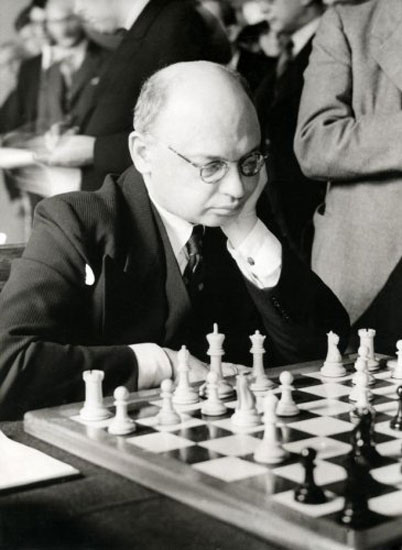
For 150 pesetas (€1000 today), in 1929, September 24 to be precise, Savielly Grigorevitch Tartakower created the Catalan Overture, also called the Catalan Gambit, the Catalan Opening, the Catalan system… or simply “the Catalan”. He took advantage in the first game of the International Barcelona Exhibition, when he had as an opponent the Italian champion Monticelli, to participate in a curious competition launched by Francesc Armengol…He had decided that his homeland, Catalonia, would have its own opening (just like Sicily, India or France). That year, when Pirandello triumphed with his Six Characters in Search of an Author, it is not surprising that Armengol sought to promote an appellation (the catalan), while he was looking for a new opening, whatever it might be. And Tartakower succeeded: by combining the initial move 1. d4 and the fianchetto of the king’s bishop he was going to offer us an example of one of the most perfect balances between the strategy of yesterday and the “hypermodern” which, at that time, had Nimzovich as its champion. The essence of Tartakower’s idea is this: occupy the center with the pawns (d4 and c4) and furthermore put pressure on d5 with the Bishop on g2. Nowadays we can say that this opening has become the favorite of players such as Smyslov or Sosonko. Botvinnik, Petrossian, and Korchnoi even used it in the World Championship. It may be that, as Ricardo Calvo suggests, during friendly or blitz games, Tartakower, Reti, and Breyer had already tried to marry this king’s fianchetto to the queen’s gambit in Vienna, at the beginning of the century…they were then young avant-garde revolutionaries who never stopped experimenting.
Savielly (Xavier) Tartakower was born on February 9, 1887, in Rostov-on-Don, to Austro-Polish and Jewish parents, but he spent most of his life in Paris, having opted for French nationality… and embraced the Catholic religion, which did not prevent the Nazis from pursuing him during the war. From 1930 to 1939 he represented Poland at the Olympic Games…without even bothering to learn the Polish language.
When, in 1950, he was the French delegate to the Dubrovnik Olympics, not only did he speak French well, but he wrote it fluently: Bréviaire des Échecs (Chess Breviary) remains an ideal manual for beginners. He died in Paris on February 5, 1956, and according to Golombek he ended his days in poverty, without even eating his fill… It is true that in his youth this grandmaster, winner of the most prestigious tournaments of his time, had declared: “You can’t live from chess, but you can die from it.”
Tartakower-L. Steiner
Lodz, 1935
1. d4 d5 2. Nf3 Nf6 3. g3 e6 4. Bg2 c5 5. O-O Nc6 6. b3 Be7 7. Bb2 O-O 8. Nbd2 Ne4 9. Nxe4 dxe4 10. Ne5 Nxd4 11. Bxe4 f5 12. Bg2 Bf6 13. Nd3 Qc7 14. e3 Nb5 15. Bxf6 gxf6 16. Qd2 c4 17. Nf4 a5 18. Rfd1 Ra6 19. a4 Nd6 20. Qc3 Qc5 21. Nh5 Qe5 22. Rd4 b5 23. f4 Qc5 24. axb5 Nxb5 25. Rxc4 Qe7 26. Qe1 Bb7 27. Qe2 Bd5 28. Rca4 Qa7 29. Qxb5 Qxe3+ 30. Kh1 Bxg2+ 31. Kxg2 Rd6 32. Nxf6+ Kf7 33. Ne4 fxe4 34. Qh5+ Kg8 35. Qg5+ Kf7 36. Rxa5 Qd2+ 37. Kh3 Rd7 38. Qh6 Rg8 39. Rg5 1-0
3. … Bf5 instead of e6 is also possible. 6. b3 is less radical than 6. c4 dxc4 7. Qa4 Bd7 8. dxc5 8. … Ne4: Steiner places himself on an outpost, which Tartakower finds unacceptable. If 9. e3 (instead of 9. Nxe4) f5, black will dominate the center. After 10. Ne5 the minor white pieces maintain a harmonious relationship. 15. … Rxf6 is inferior to gxf6 since 16. e4 e5 and 17. f4. 16. … c4 is superior to 16. … Bd7 17. Nxc5 and to 16. … Rd8 17. … a4 Nd6 18. Qc3. With 17. … a5: black tries to let his rook breathe. 20. … Qc5 black admits his delay and offers to exchange the pieces. 23. f4: pushing the opposing queen towards the least favorable square. 24. … Nxb5 (or 24. … Qxb5 25. bxc4) 27. Qe2 to prevent any counterattack: 27. Rxa5 Rxa5 28. Qxa5 Bxg2 29. Kxg2 Qb7+ followed by 30. … Ra8 31. … Rd6 threatens 32. … Rd2+ (since, if 32. Rf1 Rd2+ 33. Kh3 Rxc2 34. Rxa5 Qd2 and Black wins).
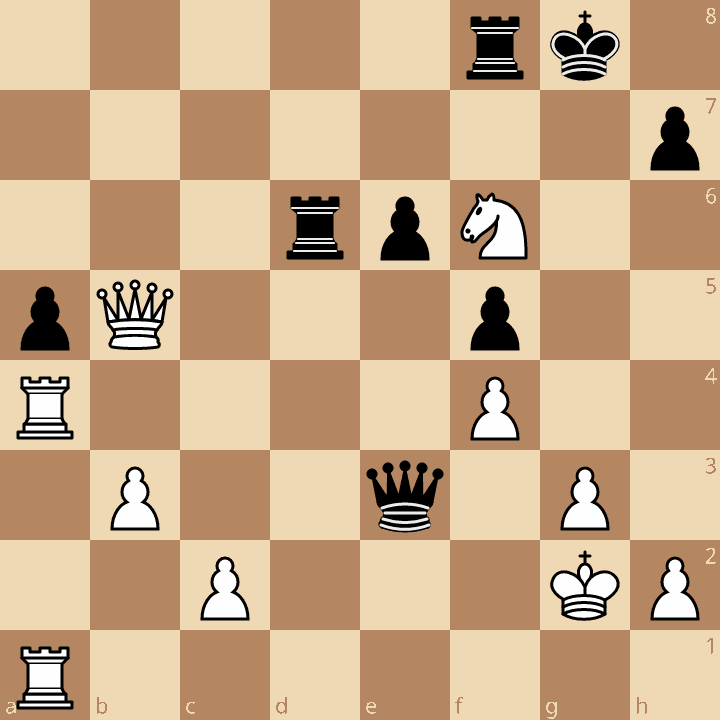
Problem No. 2 by B. Harley, Chess Amateur, May 1922.
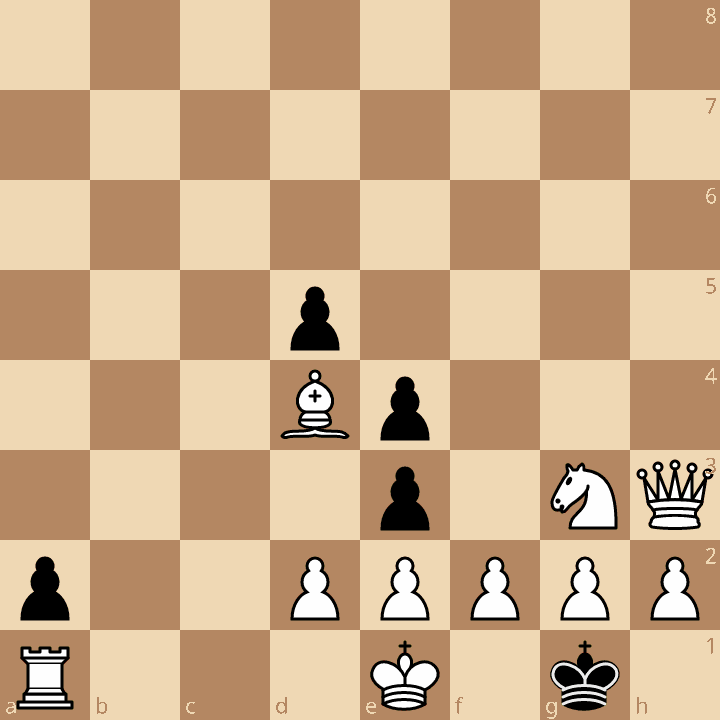
Mate in two moves.
THREE:
THE GLOOMY CHARIOT OF LIES
If liberty and the right to remain are the two pillars of any society, the cult of truth is probably the cornerstone of any civilized community. This passion for truth which inspired generations of philosophers, from the Greeks to Marx himself, in this barbaric 20th century, is being crushed by totalitarian “efficiency”. The leaders of countries where dictatorship reigns constantly trample on the truth with astonishing audacity.
1980: Olympic Committee of the USSR: “Boycotting the Olympic Games is an act directed against the athletes of the whole world and we will never adopt this attitude. Our athletes will go to the Winter Olympic Games as they have always gone to all sporting events.”
1976: The USSR and its satellite countries boycott the Chess Olympics in Haifa (Israel), which take place in the summer of 1976 without the participation of any player from a communist country.
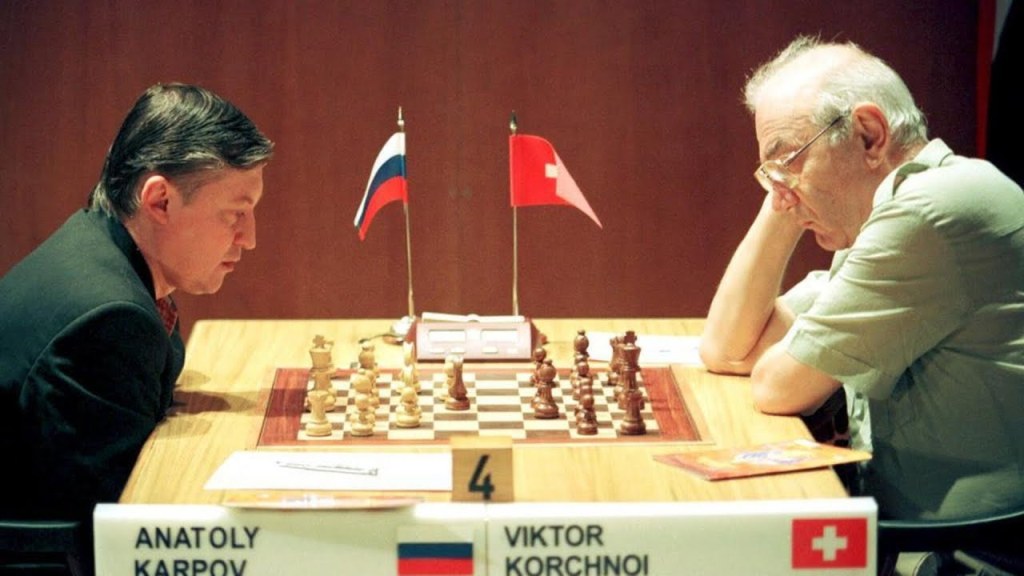
November 1979: Statement by the member of the USSR Communist Party, head of the Soviet Chess Federation, editor-in-chief of the Moscow magazine 64 and world champion Anatoly Karpov (in the American magazine Chess Life and Review): “Korchnoi is trying to exploit chess for his own purposes… He is being antagonistic… He is acting in an unsportsmanlike manner.”
December 15, 1979: The Soviet authorities, who are holding Kortchnoi’s wife, son and mother hostage, upon learning that the world championship was beginning a new cycle, sentence Igor, the dissident’s son, to the gulag.
1979: The Soviet Chess Federation, accused of boycotting tournaments in which Kortchnoi participates, declares: “Our Federation never boycotts anyone.”
1979 and 1980: Tournament organizers had to adhere to this formula: either the Soviets without Korchnoi, or Korchnoi against the Russian players, to compete with the dissident.
During the Wijk-aan-Zee tournament, which took place in January 1980 in Holland, Kortchnoi was finally seen next to a Soviet… Alburt… who, a few weeks earlier, had chosen freedom.
Karpov-Miles
European Team Championship (1980)
1. e4 a6 2. d4 b5 3. Nf3 Bb7 4. Bd3 Nf6 5. Qe2 e6 6. a4 c5 7. dxc5 Bxc5 8. Nbd2 Qc7 9. e5 Nd5 10. Ne4 Be7 11. 0-0 Nc6 12. Bd2 b4 13. c4 bxc3 14. Nxc3 Nxc3 15. Bxc3 Nb4 16. Bxb4 Bxb4 17. Rac1 Qb6 18. Be4 0-0 19. Ng5 h6 20. Bh7+ Kh8 21. Bb1 Be7 22. Ne4 Rac8 23. Qd3 Rxc1 24. Rxc1 Qxb2 25. Re1 Qxe5 26. Qxd7 Bb4 27. Re3 Qd5 28. Qxd5 Bxd5 29.Nc3 Rc8 30. Ne2 g5 31. h4 Kg7 32. hxg5 hxg5 33. Bd3 a5 34. Rg3 Kf6 35. Rg4 Bd6 36. Kf1 Be5 37. Ke1 Rh8 38. f4 gxf4 39. Nxf4 Bc6 40. Ne2 Rh1+ 41. Kd2 Rh2 42. g3 Bf3 43. Rg8 Rg2 44. Ke1 Bxe2 45. Fxe2 Rxg3 46. Ra8 Bc7
Karpov, visibly nervous in the face of Miles’ panic opening: 1. … a6, 2. … b5, enters into the Briton’s speculations with 6. a4 instead of the more serene move 6. 0-0, and soon Black finds himself harmoniously developed in the face of a rather convoluted occupation of space by White. By 9. e5 Karpov gives up the centre with a premature advance. The b-pawn (12. … b4) becomes ingrained on the queenside in an intolerable manner…which gives rise to 13. c4, and to an exchange of knights favourable to Miles; and finally to the loss for Karpov of the bishop which controlled the dark squares. 19. Ng5 and 20. Rh7 start a counterattack without any solidity, which can only end in retreat. The loss of a pawn (25. Qxe5) and the handicap of his rival’s bishop pair should have prompted the Russian champion to resign… but it was surely too painful to admit defeat in 25 moves with White against 1. … a6.
Problem No. 3: G. Stuart Green, Observer, October 1929.
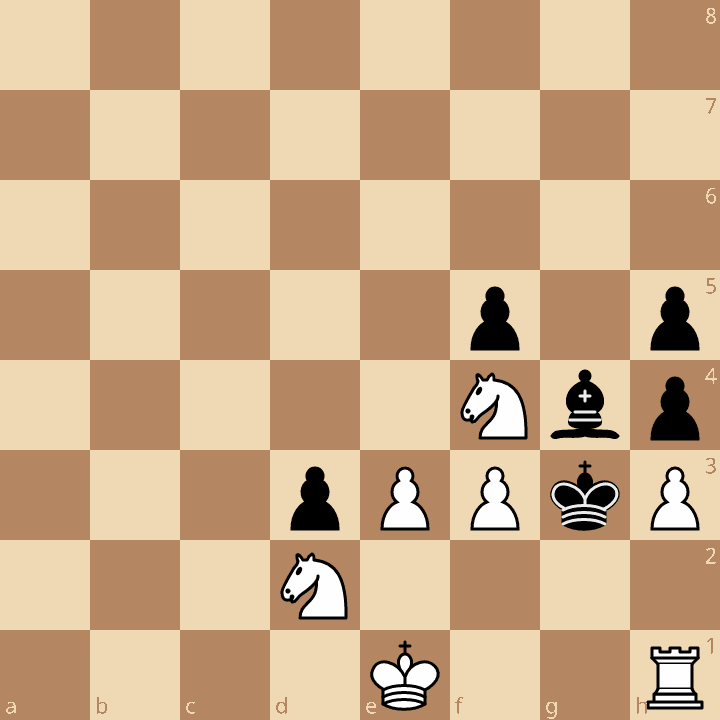
Mate in two moves.
Translator’s note: These diagrams were created using Lichess, a platform I highly recommend. To read more of my works in translation, click here.
 Kristopher Biernat
Leave a comment