
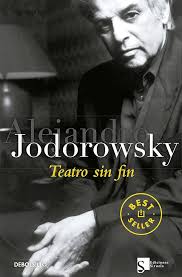
Introduction
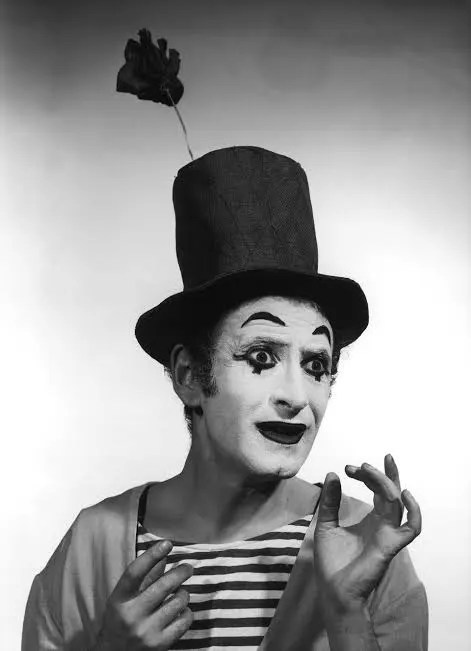
Among the numerous pantomimes I wrote for Marcel Marceau’s mime company, it seems to me that The Wings of an Angel can serve as a starting point to explain the reason for the title of this book:
A fire is extinguished. Some embers shine in the ashes. Around it, a group of beggars huddle together for warmth, trembling, and suffering from the cold. An icy wind blows… An angel appears. He feels pity for the beggars. He removes his wings and throws them into the fire. They immediately begin to burn. The beggars wake up. Heated by the flames, they are happy. They drink. They dance. One hugs a woman. Another snatches her away. They fight for her. They fight, also, for a bottle of liquor. Their anger rises. They take out knives. The angel stands between them, trying to calm them down. They stab him. While the angel dies, his wings are consumed by the flames…The beggars, fearful, carry the corpse and throw it into a large dumpster. Again, they pile up again next to the extinguished fire. Again, the cold wind blows. Suffering, they tremble. They hug each other looking for warmth. Another angel appears and takes pity on them. He removes his wings and throws them into the fire. They burn. The beggars wake up, jubilant, and heated by the fire. They start drinking and dancing. They fight. The light slowly fades.
It does not begin and it does not end. It comes from time immemorial, and it will continue as long as there are human beings: it is the ever mysterious theatre. Tragedy, drama, comedy, ephemeral, performance, religious ceremony, initiation rite, shamanic possession, act of psychomagic, sadomasochistic ritual, and so many other manifestations where those who act become others. Throughout time this escape from the prison of the self has been, in a way, a search for immortality, since the incarnated character, being of a purely spiritual nature, is an entity liberated from extinction. To play Hamlet, or to receive the powerful Ogú while in a voodoo trance, is to soak up an imaginary being who, jumping from actor to actor, defeats death.
We ourselves, locked in our terrifyingly deadly ego, implanted by the family, society, and culture, know that we are acting, that we are nor what we are but what others want us to be; we know that the limited personality that we wield like a mask while awake dissolves like a cloud while we sleep. I doubt that there is a person who is fully satisfied with such a disguise. We all want to be something more. Essential satisfaction only exists in those who achieve enlightenment. That desire to be something else is confronted in the theatre; theatre that by taking it out of its cover and extending it as a balm to all histrionic, profane or sacred activity, provides us with the opportunity to leave “ourselves” and discover the many possibilities of the essential being. After many stage experiences it became vital for me to achieve a non-exhibitionist, non-narcissistic theatre, but a theatre of coping with oneself. Shows that made me confront my emptiness. I felt disconnected from everything, far away and looking for a sense of the mask that I was. I was not a sphere with a full center, but a sphere where the surface was everything and the center was empty. In Mexico, in 1967, after declaring that I was not looking for truth, but instead authenticity, I wrote the following manifesto:
People who want to confront themselves go to the theatre because they have deserted from the masses. Having lost his contact with God, modern man needs rituals. Just as the bee constructs a hexagonal hive, the human being constructs rituals. We carry rituals in our cells: through them man reaches the top of himself. We are, for lack of the ritual, drowned in mediocrity. We are going to raise the theatre as a great ritual where actors and audiences will seek their highest values… Of course, to abandon oneself and exclusively love what is presented to us as a mirage requires faith.
Faith is in the womb. In body language, this means going down from the head to the hips. In theatrical language: leaving reason behind, returning to the most intimate of beings. The Romans referred to their stomachs when using “I”. For them, the brain was only a cooler of ideas that were born hot in the navel. To stop beating around the bush: I will express myself purely with the unconscious. I will allow it to flow on stage with the same freedom with which one passes through dreams. I will ignore the public’s intellect. Jumping over the fence of their concepts, I will communicate with them from unconscious to unconscious. I will not define symbols, but I will present them with their infinite complexity so that everyone interprets them in their own way.
It is not about mixing in with the work in such a way that it exists and we cease to; it is not about depending on the work so much that if they destroy it, it destroys us. On the contrary. It is about dispensing with the work. The work is a limited product. There are mysterious things within us that we may never know. We are a sacred receptacle that keeps within it a god who, if faith falters, can very well become a demon.
I will never be able to be satisfied with what I did, nor can I be satisfied with what I have achieved. I want more. My possibilities as a human being are endless. The more I reach, the less I have. The more I grow, the more I feel my smallness. Everything is behind, covered in sand, fossilized. I am standing looking at a huge horizon, which I will never be able to populate.
The time has come to clarify what I mean when I say “to confront”. In Greek theatre, the hero is hypocritical. Oedipus says: “I killed my father, but I didn’t know he was my father.” “I slept with my mother and had children with her, but I didn’t know she was my mother; the proof is that knowing it I tear my eyes out as a punishment.” In the theatre of confrontation the hero makes his desires known: he realizes that he is attracted to his mother. If incest seems bad to you, fight against it. If he cannot resist his impulses, he surrenders to that desire; he acts knowing what he is doing. The things happen because they could not happen otherwise. Guilt disappears. Self-punishment disappears. One evolves from “everything happens to me” to “I forge my destiny.” And what do I forge? Nothing. Any work on oneself is never creative: it is always beneficially destructive. Boundaries are broken. Psychological blocks that family, a wrong world has embedded in us are a burden. Evil does not exist, it is only forgetting goodness. The very essence of the universe, our deep plot, is love. There is no need to look for it, since we are. The problem of loving more does not arise; it would be like telling the water to be more wet. Suffering is not born of not loving but of the fact that in every action we are preventing the manifestation of the love that nests in us. Poor education serves as a barrier to that positive potential. We have to break the mental blocks so that the mask falls and our essence flows… Let’s see how we manage to find the ways that allow us to expand our love. It’s very easy to destroy things. It is difficult to express yourself in the beautiful. There is only one way to make a glass, infinite ways to destroy it. I want, in the theatre, to consider the work of making vessels, not that of destroying deformed vessels that others have made.
However, those vessels, which in my youth I had the disrespect of calling “deformed”, gave me the necessary bases to establish my own creations. In each of my theatrical works there is an influence, small or large, of shows or readings that, although they did not agree exactly with what I was looking for, enriched me. Opera Panic (2001) descends directly from the clown dialogues that I had the opportunity to see in the poor circuses in my native country, Chile. Those small tents had neither large acrobats nor spectacular beasts. They were made up of a small family that did everything: balancing acts on old bicycles, contortionist children, or “trained” starving dogs, and above all, to fill half of the function, a couple of clowns creating absurd and long interventions that went from innocent riddles with puns to reaching a high poetic and philosophical level.
-How are a living bull and a dead bull alike?
-I don’t know. Tell me.
-To run with a living bull is a mistake…
-What about the dead bull?
-It is steak!
-Mr. Businessman, I am a one man band, please hire me!
-What do you know how to play?
-I know how to play everything, everything.
-Do you know how to play the piano?
-I know how to play everything! Everything except for the piano.
-Do you know how to play the violin then?
-I know how to play everything! Everything except for the piano and the violin.
-Do you know how to play the flute?
-I know how to play everything…everything except for the piano, the violin, and the flute…
(And so the dialogue was prolonged while the businessman asked him if he knew how to play different instruments and the clown was accumulating them in his long list of what he did not know how to play. In the end, the businessman, desperate, shouted at him:)
-Enough, tell me once and for all the only thing you know how to play!
-The only thing I know how to play is…you!
(And the clown, extending his greedy hands, pursued the businessman with such ambiguous intention that it was not known if he wanted to caress him, beat him, or kill him.)
-What are you?
-Me? I’m a foreigner.
-From where?
-From Abroad!
When I heard that last dialogue I laughed so hard it made me want to cry. They revealed to me that I was a foreigner from abroad, a name that I could give to the magical country of the unconscious. The characters of Opera Panic, like those humble clowns, disdain psychological viscosity, and in the same way that the businessman and the clown do, collide with each other, autistic impenitents, without changing their behavior an iota. It is possible that our consumer societies are producing masses of such spawns.
If I had not directed Michel de Ghelderode’s The School of Jesters, perhaps I would never have imagined Ventriloquist School (2002). In Ghelderode’s work, fifteen monsters seek the truth through their physical defects, which are like a mirror of the world. Their teacher is a melancholic and beautiful jester who reveals the “truth” to them: The secret of all art is cruelty! I didn’t believe, nor do I believe, in cruelty. There are two ways of knowing: by love or by hatred. The difference is that knowledge through hatred destroys the object studied, while knowledge through love builds it. I added a text to The School of Jesters. One of the monsters says: “Through the orbit of an empty skull, I saw a flower emerging… Death is the source of all life and hatred can only generate love.” I think that’s the secret and fundamental issue of my Ventriloquist School…
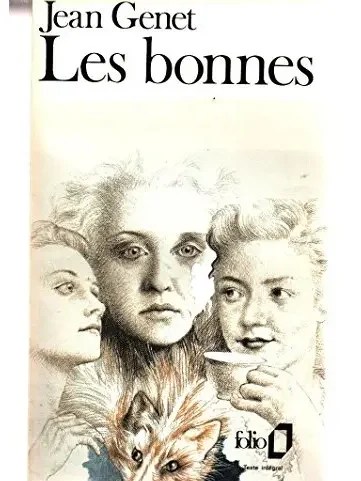
In Jean Genet’s Maids, only women who indulge in virulent relationships evolve on stage. This author said: “If theatre is a mirror of life, I have to use a lewd language, because it is the one that is used in reality.” It is possible that my inner Lucifer created The Three Old (2003) as an overwrought response to Genet’s work. In theirs, women are servants, in mine they are aristocrats who have lost their wealth, but they retain the language and prejudices of their dying class. Of course, after torturing them I give them the opportunity to survive if they stop demanding that the world adapt to them and, instead, they adapt to the world.
I would not have written Hipermercado (2004) if at the age of twenty, at the Municipal Theatre of Santiago de Chile, I had not seen an extraordinary representation of Six Characters in Search of an Author by Luigi Pirandello. Those six imaginary egos trying to possess and eliminate the personality of the individual who embodies them, to become real, moved me deeply. I realized that around the region that I thought was my identity they were crying out to express themselves other possibilities of being…In Hipermercado I adopt a reverse attitude: the characters struggle to disappear so that the actress or the actor who embodies them emerges. The intention is not metaphysical, as in Pirandello, but therapeutic.
The Endless Dream (2006) is inspired by August Strindberg’s Dream. The Swedish writer breaks the continuity of the story and incorporates the language of dreams, where spaces and times are intermingled with characters whose identities intersect. A goddess falls on our earth and is successively incarnated in a multitude of characters, assimilating her weaknesses, sufferings, vain illusions. It is a monumental work that requires a true army of interpreters. In The Endless Dream I reduced the multitude of actors to only one man and one woman, who are the two essential beings who will live the whole of human suffering. There, in a way, I try to abandon Strindbergian criticism and complaint to reach a theatre of affirmations.
Pedrolino (1998) is a mimodrama – theatre without words – that mime Marcel Marceau asked me to write for his company. In this work I include, in addition to pantomime, ballet and circus. Pedrolino could be my answer to the movie The One Who Gets Slapped, by Boris H. Hardy, based on a play by L. N. Andréiev: a cultured man is betrayed by his wife, his scientific work is stolen, he falls into misery and is forced to work as a clown in a circus where his act consists of being slapped again and again, provoking the laughter of the public. In Pedrolino, the central character -based on the image of Marceau- because the Nazis have destroyed his hands, he is forced to abandon the delicate gestures of pantomime and wear boxing gloves to, having been turned into a clown, slap everyone. The hero turns his fall into an ascent… In this mimodrama the main character is an old man because, when Marceau asked me, he had just turned 75.
At about 8 years of age I read in the Araluce Library’s collection a book, printed in Spain, entitled Stories of Shakespeare, composed of prose summaries, for young readers, of several works by the famous playwright. They amazed me: Puck, Falstaff, Titania, Oberon, the peasant with the head transformed into that of a duck, the fairy queen, the hunchback king, the knights in love, the jealous Moor, etc. Suddenly, this year, when I saw for the umpteenth time a boring staging of Hamlet, I wanted to write a popular drama that was as fun as those summaries that I was passionate about in childhood, with kings, princes, wild girls, faithful servants, battles, murders, incest, betrayals, rebellions, miracles, etc. That’s how, with childish euphoria, I wrote Royal Blood (2007).
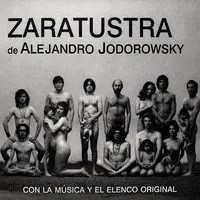
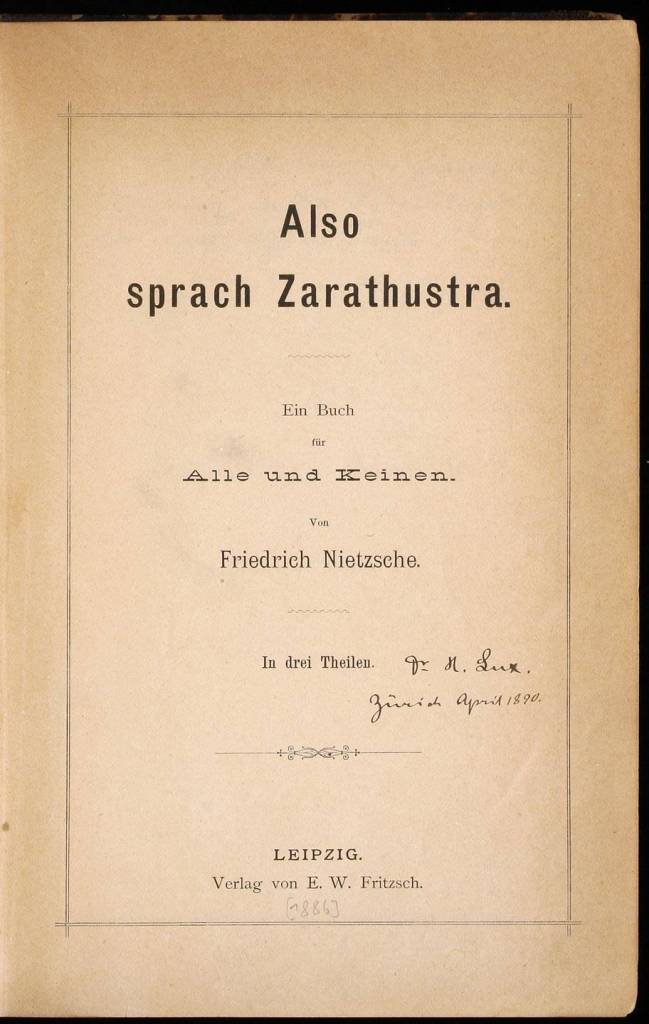
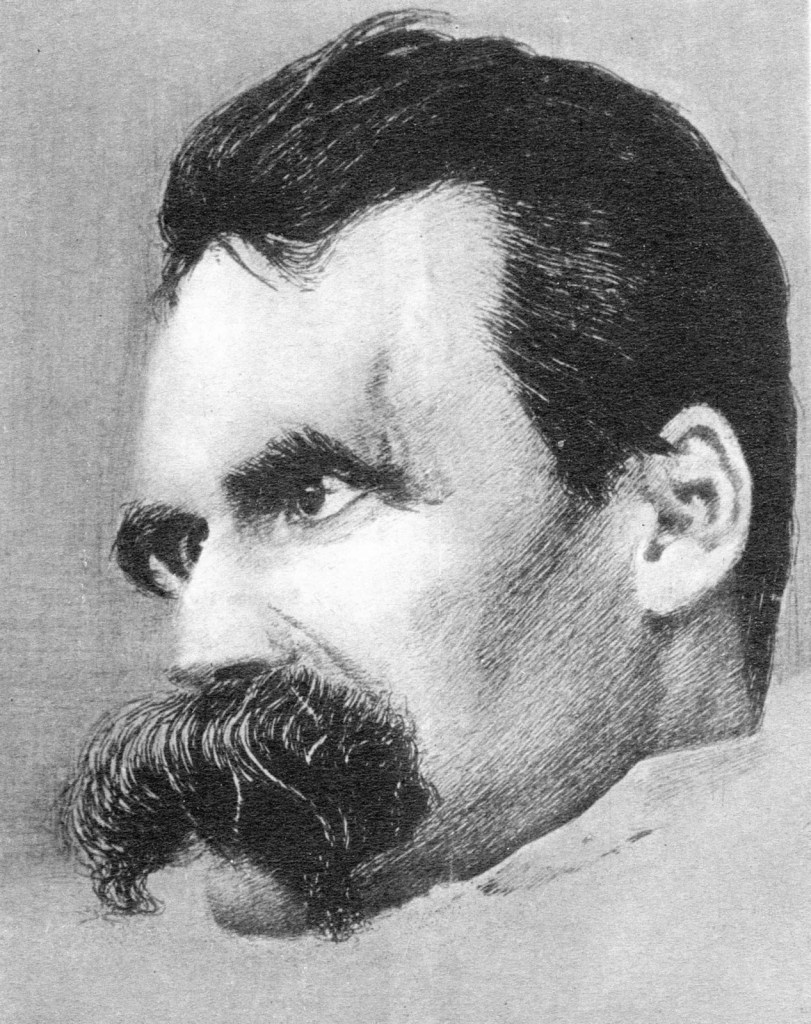
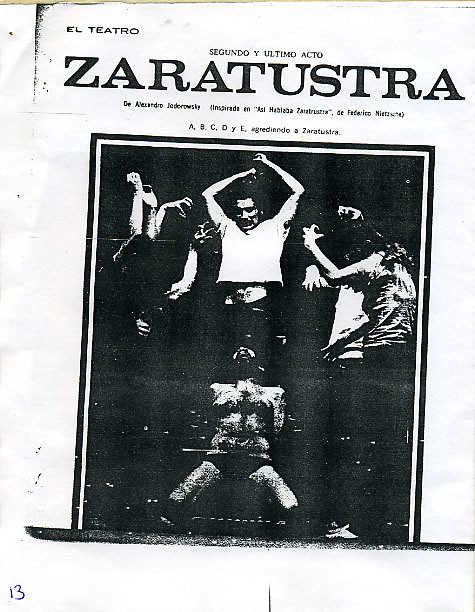
Zarathustra (1970) is an attempt to dramatize the book Thus Spoke Zarathustra by Friedrich Nietzsche. I owe the content of the first act to the German philosopher. In the second act I fly with my own wings.
My 1967 theatre manifesto ended with these words, in which I still believe:
Strindberg, with his stomach cancer, said: “Nothing is personal.” Just like Strindberg, in that state of agony that is the search for depersonalization, I write. I say to myself: “What do I have to say as my last words?” The theatre is a playful funeral ceremony. In it we are exhibiting and then killing our false egos.
In the world of reason we are accustomed to saying that for each problem there is a precise solution. But life is not like that. In it a problem does not have a single and perfect solution but an infinite number of solutions. The solution we choose for a certain problem is one that is useful at any given time. But immediately this solution can and must be abandoned because, having mutated the situation, it ceases to be useful. The important thing is the useful solution, and not the one that reason finds “truthful”. In the face of infinite solutions, it is preferable not to seek the truthful but the authentic.
The theatre must be authentic and untrue. In looking for the useful solution, you will find authentic situations. There is no theatre of authenticity, just as there is no art that is not useful: a catharsis of being. The ancient Greek tragedy presented in each of its works two essential components, of which psychoanalysis became the spokesman: Eros and Thanatos, sex and death. The theatre was a ritualistic act where, in each performance, the myth of incest was revived and the desperate struggle of the heroes unable to free themselves from fate became a true collective therapy, a sublime and necessary art, useful for authenticity. The myth has a purifying function: Representing contents of the unconscious that are forbidden to us by reason, it exorcizes the ghosts, the dark side of being. Authentic theatre speaks of our big questions (Where do we come from? Who are we? Where are we going?) And guides them towards positive catharsis, which allows the public to fully live the primordial and essential anguish (being mortal) to overcome it and undertake the search for a new solution. That is why authentic theatre cannot be representative, but “re-presentative”, integrating into the present the strength of mythical contents.
When theatre is used to present “truths”, that is, acts that advance in a single direction where the intellect imposes on us the great and definitive eternal solution, it becomes a lackey of doctrines. Authentic theatre re-presents what is useful, to mitigate the original dilemma of the human being, with its primary uncertainty, weakness, insecurity, terror, which once brought to consciousness becomes certainty, strength, security and compassion.
If the “truth” speaks in the name of politics, religion, everyday reality, Aristotelian logics plunging us into mental prison, instead authenticity produces Art, a useful activity to heal the family, social and cultural disease into which we have fallen for having denied the myth.
Translator’s Note
Lately I have been spending a lot of time translating works that are of interest to me, and that I feel aren’t very well represented in the English language (such as the works of Emmy Hennings, Fernando Arrabal, Jean Cocteau, and, of course, Alejandro Jodorowsky). It is a crime that so little of Jodorowsky’s work outside of film and comics remains untranslated. Slowly I aim to remedy this, and hopefully inspire a better translator to take on this project.
Jodorowsky’s works (namely his poetry and theatre) provide so much insight and beauty that I feel the English speaking world, particularly those of us in The United States of 2026, could truly benefit from.
-Kristopher Biernat, Chattanooga, TN, 2026.
 Kristopher Biernat
Leave a comment