
THE LAST JOY
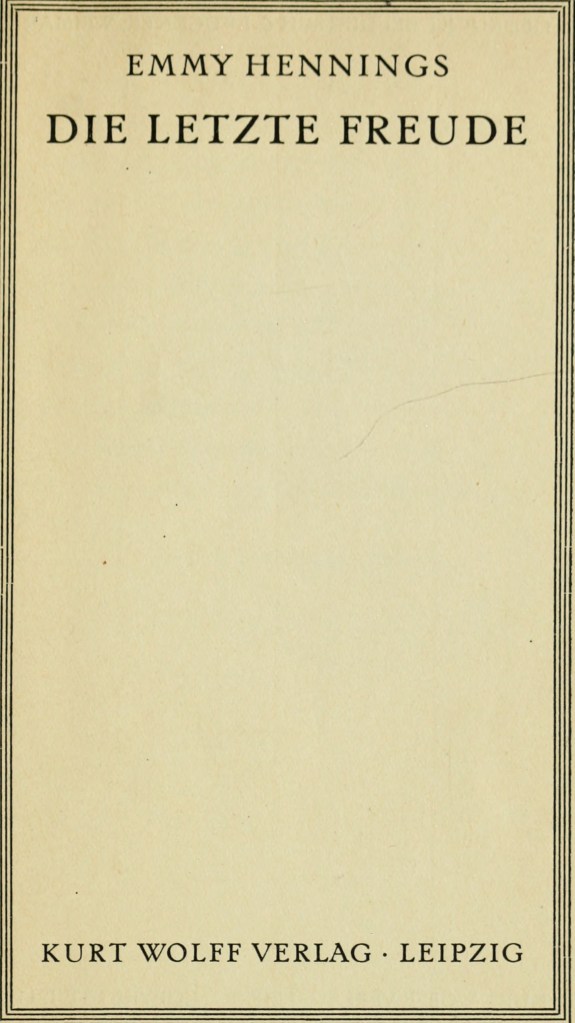
DIE LETZTE FREUDE
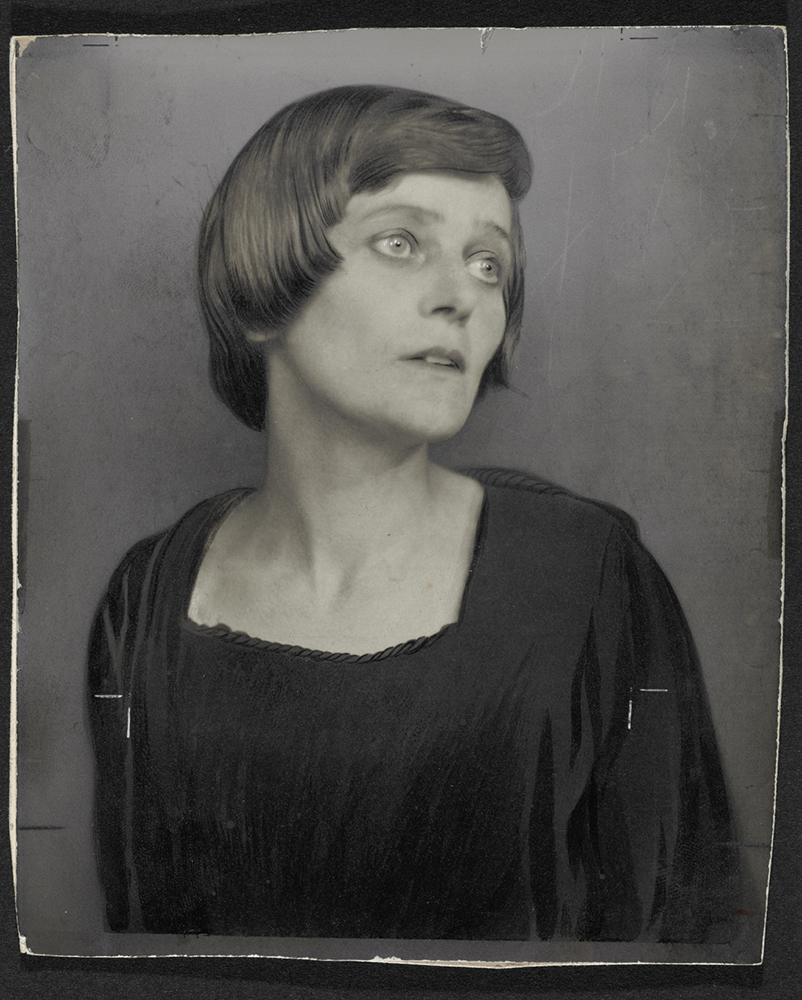
Poems by Emmy Hennings
Translated from the German by Kristopher Biernat
CONTENTS
- ETHER STROPHS (ÄTHERSTROPHEN)
- IN FRANCE (AN FRÄNZI)
- A DREAM (EIN TRAUM)
- HYPNOSIS (HYPNOSE)
- AT MY HOME (BEI MIR ZU HAUSE)
- IN THE HOSPITAL (IM KRANKENHAUSE)
- AFTER THE CABARET (NACH DEM KABARETT)
- AFTERWORD FROM THE TRANSLATOR
ETHER STROPHS (ÄTHERSTROPHEN)
This poem is for Hardy
Now I must fall from the great sphere–
all the while, there’s a beautiful festival in Paris.
People are gathering at the Gare de l’Est.
Colorful silk flags are waving.
I am not among them.
I am flying in the vastness of space.
I am mingling in every dream.
I am read within a thousand expressions.
A sick man lies in his misery,
and his last gaze hypnotizes me,
longing for a summer’s day…
A black cross fills the chamber…
///
Jetzt muß ich aus der großen Kugel fallen.
Dabei ist in Paris ein schönes Fest.
Die Menschen sammeln sich am Gare de l’est
Und bunte Seidenfahnen wallen.
Ich aber bin nicht unter ihnen.
Ich fliege in dem großen Raum.
Ich mische mich in jeden Traum
Und lese in den tausend Mienen.
Es liegt ein kranker Mann in seinem Jammer.
Mich hypnotisiert sein letzter Blick.
Wir sehnen einen Sommertag zurück . . .
Ein schwarzes Kreuz erfüllt die Kammer . . .
(Dieses Gedicht ist für Hardy)
///
Dedicated to Robert Jentzsch
The rain beats against the windows.
A flower glows red.
A cool breeze blows towards me.
Am I awake, or am I dead?
A world lies far away, very far away,
A clock strikes four slowly,
and I know nothing of time,
I fall into your arms…
///
An die Scheiben schlägt der Regen.
Eine Blume leuchtet rot.
Kühle Luft weht mir entgegen.
Wach ich, oder bin ich tot?
Eine Welt liegt weit, ganz weit,
Eine Uhr schlägt langsam vier.
Und ich weiß von keiner Zeit,
In die Arme fall ich dir . . .
(Robert Jentzsch gewidmet)
///
And at night in deep darkness,
pictures fall from the walls,
and someone laughs so brazenly and broadly,
they reach for me with long hands.
And a woman with green hair,
she looks at me sadly,
and says that she was once a mother,
she cannot bear her suffering.
(I press thorns into my heart
remaining still,
and I will suffer every pain,
because they want it of me.)
///
Und nachts in tiefer Dunkelheit,
Da fallen Bilder von den Wänden,
Und jemand lacht so frech und breit,
Man greift nach mir mit langen Händen.
Und eine Frau mit grünem Haar,
Die sieht mich traurig an
Und sagt, daß sie einst Mutter war,
Ihr Leid nicht tragen kann.
(Ich presse Dornen in mein Herz
Und halte ruhig still,
Und leiden will ich jeden Schmerz,
Weil man es von mir will.)
IN FRANCE (AN FRÄNZI)
Lonely
I walk through the alleys,
and evening falls.
Softly
I sing your songs.
Ah, I feel so forsaken.
In the pale red light,
oh, how sorrowful your mouth was,
sweet and pale your face,
and your folk song
so heartfelt.
Eyes that knew tears,
that experienced
love’s sorrow,
like two dark stars,
in which fires burned softly…
///
Einsam geh ich durch die Gassen,
Und der Abend senkt sich nieder.
Leise sing ich deine Lieder.
Ach, ich fühl mich so verlassen.
In dem fahlen roten Licht,
O, wie war dein Mund so schmerzlich,
Süß und bleich dein Angesicht,
Und dein Volkslied klang so herzlich.
Augen, die die Tränen kannten,
Die der Liebe Leid erfahren,
Die wie zwei dunkle Sterne waren,
In denen leise Feuer brannten . . .
A DREAM (EIN TRAUM)
We lie in a deep lake
and know nothing of sorrow, of woe.
We embrace each other
and water lilies surround us.
We strive and wish and want nothing more–
we have no desire.
My love, a piece of me is missing,
one wish I still have:
To long for the sake of longing.
///
Wir liegen in einem tiefem See
Und wissen nichts von Leid und Weh.
Wir halten uns umfangen
Und Wasserrosen rings um uns her.
Wir streben und wünschen und wollen nichts mehr.
Wir haben kein Verlangen.
Geliebter, etwas fehlt mir doch,
Einen Wunsch, den hab ich noch:
Die Sehnsucht nach der Sehnsucht.
HYPNOSIS (HYPNOSE)
For Siurlai
My body aches somewhere in a foreign land,
I can no longer feel my body,
my feet are as heavy as lead,
my chest is hollow and burnt out.
Nothing hurts and yet I am filled with pain,
I gaze into your eyes, spellbound.
I fall asleep, candles’ flames dancing,
lighting my way into unknown lands.
///
Mein Leib schmerzt, irgendwo in einem fremden Land,
Ich fühle meinen Körper längst nicht mehr,
Die Füße sind wie Blei so schwer,
Die Brust ist hohl und ausgebrannt.
Mir tut nichts weh und bin doch voller Schmerzen,
Ich seh in deine Augen wie gebannt.
Ich fall in Schlaf, es flammen Kerzen,
Sie leuchten mir ins unbekannte Land.
(Für Siurlai)
AT MY HOME (BEI MIR ZU HAUSE)
My grandmother kept watch all night:
;;;A light burned in the green glass;;;
Before a barred window, she kept watch,
I investigated her pale face.
The furniture in the blue room,
all of our sorrow clings to it.
And when someone dies at this time,
the clock stops with a sick whimper.
///
Meine Großmutter hielt die ganze Nacht
— Im grünen Glase brannte ein Licht —
Vor einem vergitterten Fenster Wacht,
Ich sah in ihr fahles Angesicht.
Die Möbel in dem blauen Zimmer,
An ihnen haftet all unser Leid.
Und wenn jemand stirbt, um diese Zeit
Bleibt stehn die Uhr mit krankem Gewimmer.
IN THE HOSPITAL (IM KRANKENHAUSE)
All autumns pass me by.
Sickly, I lie in the white room,
I’d much rather be dancing.
I always think of the violins,
and a thousand lights flicker.
Oh, how beautiful I am today!
Colorfully made-up faces
swiftly blow by in the dance.
Oh, the many withered roses,
that I carried home at night,
that were crushed by so much caressing
laying on the table in the morning.
I think again of the girls,
who, like me, make love.
When we sang folk songs,
amidst tears, amid laughter.
And now I lie all alone
in the silent white room.
Oh, you sisters from the streets,
come to me in my dreams at night!
///
Alle Herbste gehn an mir vorüber.
Krank lieg ich im weißen Zimmer,
Tanzen möchte ich wohl lieber.
An die Geigen denk ich immer.
Und es flimmern tausend Lichter.
O, wie bin ich heute schön!
Bunt geschminkte Angesichter
Schnell im Tanz vorüberwehn.
O, die vielen welken Rosen,
Die ich nachts nach Haus getragen,
Die zerdrückt vom vielen Kosen
Morgens auf dem Tische lagen.
An die Mädchen denk ich wieder,
Die wie ich die Liebe machen.
Wenn wir sangen Heimatlieder,
Unter Weinen, unter Lachen.
Und jetzt lieg ich ganz verlassen
In dem stillen weißen Raum.
O, ihr Schwestern von den Gassen,
Kommt zu mir des Nachts im Traum!
AFTER THE CABARET (NACH DEM KABARETT)
Dedicated to Ferdinand Hardekopf
I go home early in the morning.
the clock strikes five, it’s already getting light,
but the lights are still on in the hotel.
The cabaret is finally over.
Children huddle in a corner,
the farmers are already driving to the market,
people go to church quietly and wet with years.
The bells ring solemnly from the tower,
and a prostitute with wild curls
wanders about, sleepless and cold.
I’ve been born twice already,
back then I sang for money too,
but the world seemed sunnier to me,
and I’ve lost my cheerfulness.
Time passes somewhere in the distance,
in my arms I feel it slipping away.
I think of my first beginning.
How deeply infinity confuses me!
Lonely, I wander through the nights and think of you.
Sometimes I see a coat that resembles yours.
And then I softly call your name,
and my heart stands still with grief.
Wearily, I lean against the wall and close my eyes-
slowly, many tears trickle to the ground.
The world recedes far behind.
I drift through white clouds into open arms.
A shower of rose petals falls after me and cools my weary eyes.
Everything is so white and delicate.
Oh, so sweet.
///
Ich gehe morgens früh nach Haus.
Die Uhr schlägt fünf, es wird schon hell,
Doch brennt das Licht noch im Hotel.
Das Kabarett ist endlich aus.
In einer Ecke Kinder kauern,
Zum Markte fahren schon die Bauern,
Zur Kirche geht man still und alt.
Vom Turme läuten ernst die Glocken,
Und eine Dirne mit wilden Locken
Irrt noch umher, übernächtig und kalt.
Schon zweimal wurde ich geboren,
Und damals sang ich auch für Geld,
Doch sonniger schien mir die Welt,
Und meine Munterkeit hab ich verloren.
Irgendwo in der Ferne vergeht die Zeit,
In meinem Arme fühl ich sie entrinnen.
Ich denke an mein erstes Beginnen.
Wie tief verwirrt mich die Unendlichkeit!
Einsam irr ich durch die Nächte und denke an dich.
Manchmal sehe ich einen Mantel, der deinem gleicht.
Und dann rufe ich dich leise beim Namen.
Mein Herz steht still vor Trauer.
Müde lehne ich mich an die Mauer und schließe die Augen.
Langsam rinnen viele Tränen zur Erde.
Die Welt bleibt weit zurück.
Ich wehe durch weiße Wolken in offene Arme.
Ein Rosenregen fällt mir nach und kühlt meine kranken
Augen.
Alles ist so weiß und zart.
Ach so süß.
(Ferdinand Hardekopf gewidmet)
AFTERWORD FROM THE TRANSLATOR
I would like to express my gratitude to poet Rose Knapp for bringing this poet’s work back into my attention. Also, much is owed to Nadia Arioli for her dedication to Kay Sage (and recent interest in Dora Maar), bringing overshadowed women into the conversation. Lastly, thanks is owed to the late Franz Wright, who taught me much about translation, and to Cid Corman, who I was too late to meet.
I do not speak German, I only speak German.
This is the version I used, via the phenomenal Project Gutenberg.
Originally Published by Kurt Wolff Verlag in Leipzig, 1913. Translation by Kristopher Biernat, Chattanooga, TN, USA, 2026.
 Kristopher Biernat
Leave a comment