
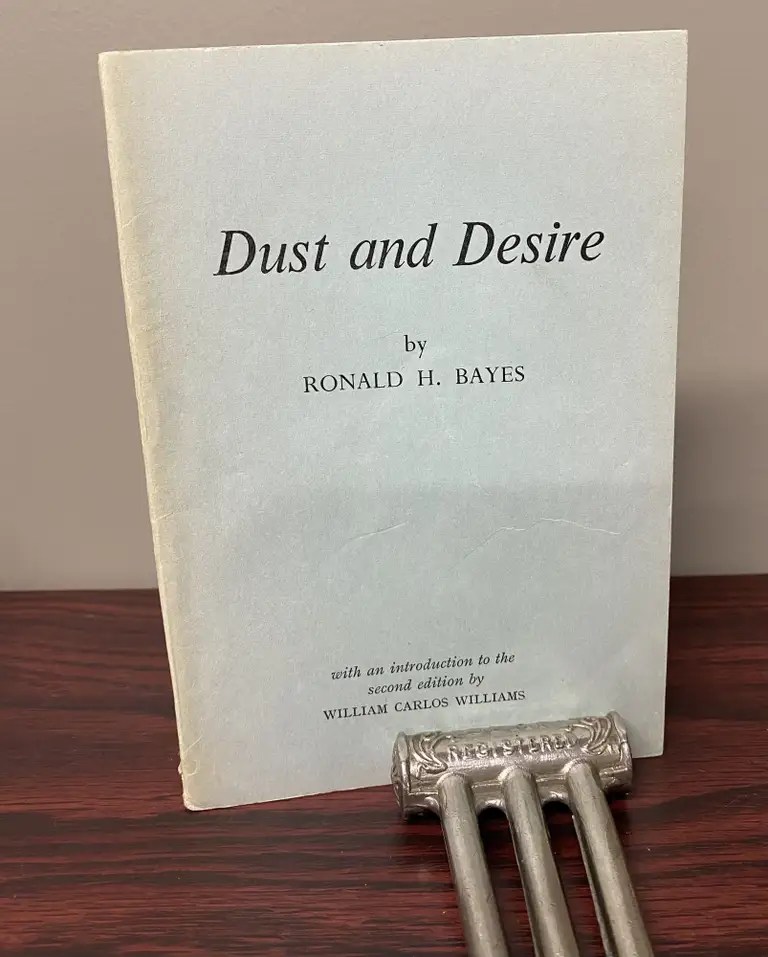
In the early 2010’s I discovered a small poetry collection at a used bookstore near Asheville, North Carolina. The collection was stained, tattered, and cheap. Most notably for me at the time, it had an “introduction” by William Carlos Williams, who I was obsessed with at the time. That collection was the second edition of Dust and Desire (Arthur H. Stockwell Limited, 1962) by Ronald H. Bayes.
I devoured that collection that evening and have returned to it often over the years. Below is William Carlos Williams’ introduction, which is actually just a reprint of a letter he sent to Bayes in 1960.
Your style in these poems shows that the American idiom as well as the variable foot is your constant concern. The present and the future of the language we speak depends on your generation–the vigor of your attack on the problems with the language is very important to me, it’s up to you of the present generation to carry it forward.
You have been inoculated with the authentic virus. I like your poems…I must be forgiven if I show a weakness for Lydette which is more lyrical than some of the others; that comes through to me perfectly. I want to test the ear of a poet if I am to accept him and in this poem you reveal a perfect ear. I am grateful. I am conscious of a perfect ear in whatever you write but The American must be strictly adhered to if it is to succeed. You do just that…
I’m proud of you as an artist, your intelligence shows no sign of weakening under the strain the measure puts you under. As craftsmen it would be better if we lived closer together as they did in London or Florence during the sixteenth century for a nearby exchange of ideas but we’ll have to do the best we can… Right now with a new language to work on if we are up to it we have at least a chance. Let’s see what we can make of it.
Rutherford, New Jersey
June 1960

Ronald H. Bayes was born on July 19, 1932 in Oregon. After a brief stint in the Army, he lived and studied oversees in Europe and Asia.
In 1968 he moved to Laurinburg, North Carolina and accepted a position at St. Andrews, founded the St. Andrews Review, which Allen Ginsberg called “the best, most up-to-date literary magazine since the Black Mountain Review.” In 1969, he helped found St. Andrews University Press, which has published authors such as Hiroaki Sato, Barry Gifford, Joel Oppenheimer, and Joseph Bathanti.
Over his long career he published over a dozen collections of poetry, fostered a community of poets in North Carolina unseen since the days of Black Mountain College, and taught hundreds, if not thousands of students. His friends and admirers included Yukio Mishima, Robert Creeley, Jonathan Williams, Joel Oppenheimer, James Laughlin, Wallace Fowlie, and Ezra Pound. Bayes passed away December 12, 2o21 at the age of 89.
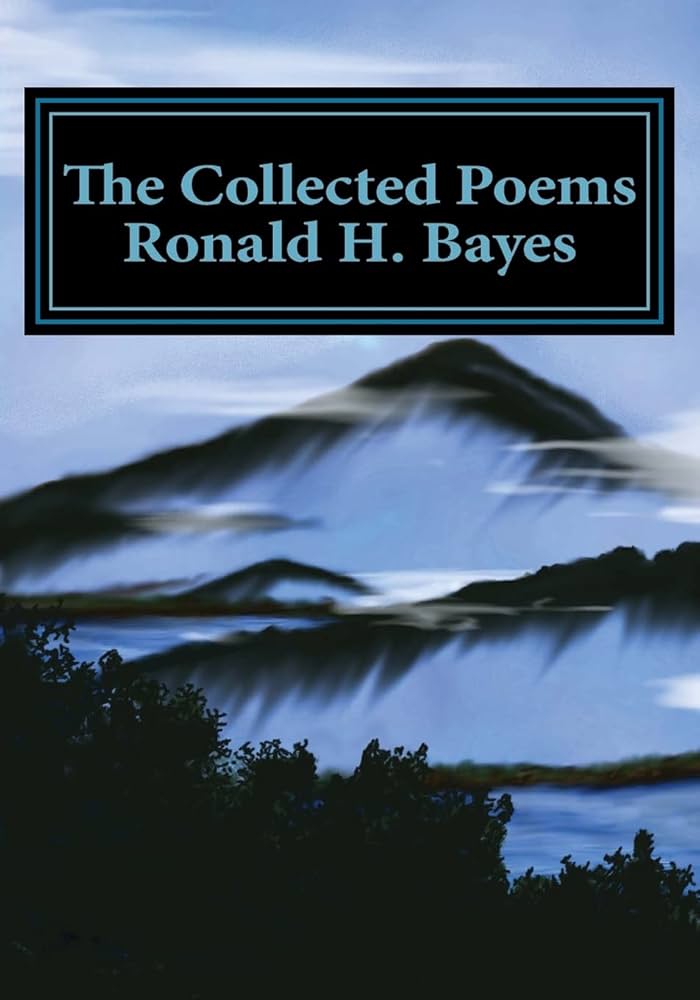
Aside from exchanging a few brief letters (essentially fan letters met with a thank you notes) I did not have the pleasure of personally knowing Mr. Bayes. From those I have spoken to who did know him, he seems to have been a genuine soul, and that shows in his poetry. Bayes’ poetry to me varied wildly in form from poem to poem, collection to collection, but always felt experimental in a personal sense. Bayes did not seem to be afraid of trying new methods, or of publishing the results. When reviewing his Collected Poems (released in 2015 by his St. Andrews University Press) one can really appreciate the depth of his knowledge and his experimental streak. I have added six of Bayes’ poems that have been particularly influential to me below, including the poem Lydette that William Carlos Williams expressed a particular fondness for, and two translations. The final poem is especially fitting as this is being posted on July the fourth, 2024. I highly recommend purchasing his Collected Poems, however if you are unable to due to a lack of shelf space (it truly is a brick of brilliant poetry), it is available free here via The Internet Archive.
Lydette
Gay and garlanded
Down to the dockside
My love came running.
Warm that welcoming
By azure waters,
And both of us laughing.
So shall I love her,
Hearing her laughter
At each journey’s end,
Never forgetting my
Smiling and flowered,
My dear love, running.
The Sea Groaned (by Chiyoko Terayama, translated with Nobuaki Sumomogi)
Clock becomes sea.
Starts to strike,
becomes dry cosmos.
To begin with, the falling petals of cosmos.
And the violent keys split
to the second. Mechanical cut ear.
Sea motionless.
Time broken.
Again the
sea groaned
in the show-window.
The Sand Clock (by Naoko Ban, translated with Nobuaki Sumomogi)
The surging air,
the falling light,
the ebb-tide echoes, echoes.
Rose scent hangs
to the white sail.
Summer hanging on is cruel.
The modern city?
Cymbals crash.
Explosions and hymns: “Which is that?”
Clock shrinks.
Waltz dies.
Space spaces our time into cut.
Plum and Apricot: Apple and Rose
Wise in
their way they
left us by ourselves,
that we could hold our hearts,
each the other’s
three dawns.
Two Aphorisms
I.
Exile:
Purer than sell-out.
II.
Re-dedicate in action
The product of that seen in fact by your own eye,
and that gained in meditation,
As one returns the perfect seed to the soil
And not to the shelf.
Passus 22
- MAGPIE GRACEFUL AS A GULL
BALANCES
ON THE WIND - A RELATIVITY OF EYES
- A TENDANCY
TO WANT TO KISS PEOPLE - CONFUSION ON QUIET
FOURTH OF JULYs - DESIRE FOR BASTILLE DAYS
- PSYCHOSIS MUCH AS
A KILL-DEER HAS
& flights similarly patterned - CONFUSION EVER SINCE FOURTH
OF JULYs
BECAME QUIET.
NEEDING SKYROCKETS
FIRECRACKERS
ROMAN CANDLES &
SEVERALPHRASE AIRBOMBS
even at the expense
of a few fingers and fires.
Peace in this world
is a quiet thing
& quiet relative…
 Kristopher Biernat
Leave a comment