One of my favorite films is 1994’s Relics: Einstein’s Brain. I am hesitant to say ‘documentaries’ for some reasons I’ll outline below, though some evidence exists supporting the film.
I first came across this strange film while doing research on Einstein. I knew a fair amount about his body of work, but very little about his body, especially what what had happened to it after his death, when going in. Upon his death in 1955 his brain, and eyes, went missing during the autopsy.
Nearly 40 years after Albert Einstein’s death, Japanese professor Kenji Sugimoto went on a roadtrip across America that ultimately led to Lawrence, Kansas. Those who know me know that Lawrence holds a special place in my heart. It was the home to one of my favorite authors, William S. Burroughs, for the last few years of his life.
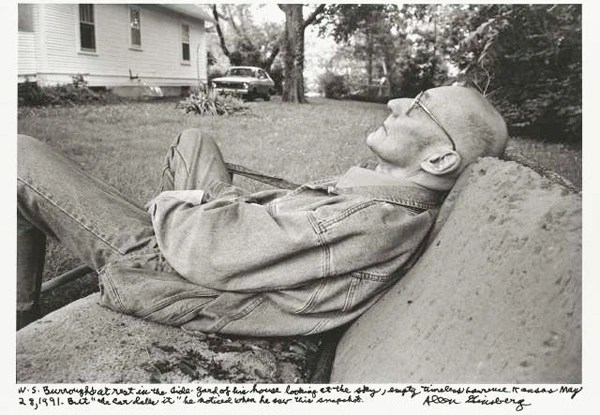
At the time of discovering this film I was much deeper in my Burroughs obsession than I am now. To my shock, Burroughs even makes an appearance (around the 42:50 mark in the video linked above) that I was not expecting. One of the elements that leads me to believe this film may not be 100% truthful. He appears as, seemingly, the proprietor of a shop named “Bill’s TV”. The pair discuss a film of the atomic bomb supposedly shot in Lawrence, then Burroughs provides directions to Dr. Thomas Harvey’s home close by. Dr. Harvey was the man who performed Einstein’s autopsy and, supposedly, stole his brain.
*Note: Spoilers for the film/documentary below.
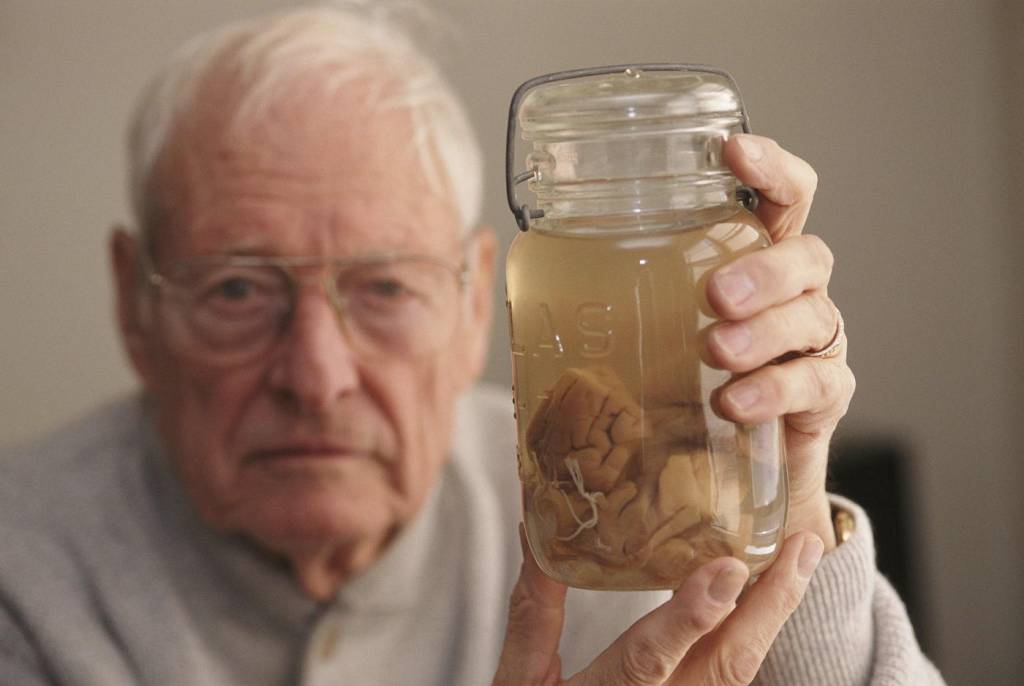
When Sugimoto arrives at Dr. Harvey’s home he is provided some closure. Dr. Harvey, indeed, has a part of Einstein’s brain. Better yet, he even gives a piece to Sugimoto, who later sings karaoke to it in Kansas City- a horrifyingly beautiful display that ends the film.
Whether this film is truthful, or some of it was staged, it is a truly wild ride. Sugimoto is intense and driven, that alone is worth it, and is something we can draw from in our own lives. Plus it is always amazing to see and hear William Burroughs’ iconic drawl.
 Kristopher Biernat